


Why a blunt knife is the dangerous one
A sharp blade goes into an onion where you put it. A blunt one skids off the skin, and your other hand is right there. Most kitchen injuries happen with the knife people describe as too dull to be a problem.
The angle is the hard part, and the slot holds it
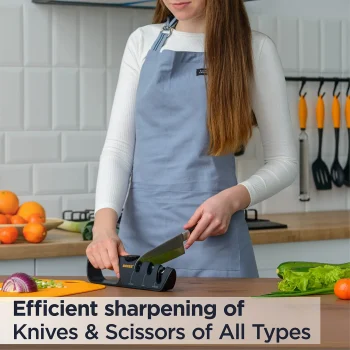
Sharpening on a stone means holding a consistent angle for every stroke — a real skill, and the reason most home knives never get sharpened. A pull-through holds the angle for you. You draw the blade back towards yourself a few times with light pressure, and that is the whole technique.
Two stages, in order
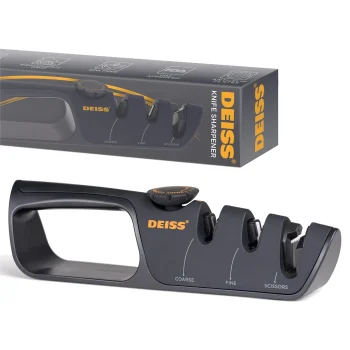
The coarse slot cuts a new edge on a blade that has gone properly blunt. The fine slot polishes that edge smooth. On a knife you sharpen regularly you only need the fine one; the coarse is for rescuing something that has been neglected.
It has to stay still
Non-slip base and a handle you hold in a full hand. A sharpener that slides while you pull a knife through it is worse than none.
Not the right tool if…
You own Japanese knives ground to a fine single-bevel edge, or serrated blades. Those want a stone or a specialist tool — a pull-through will take metal off the wrong part. For standard European kitchen knives it is exactly right.
Registered, it carries our lifetime warranty. Two minutes, and it’s ours to replace.


Reviews
There are no reviews yet.