Almost every method of judging whether meat is done is unreliable. Colour depends on the cut and how it was stored. The press test depends on your hands and your pan. Timing depends on a starting temperature nobody measures and an oven that is probably not the temperature it claims.
Internal temperature is the one signal that does not lie. A thermometer turns “I think it’s ready” into a fact, and it takes about three seconds.
The numbers worth remembering
| What | Take it off at |
|---|---|
| Chicken and turkey | 74°C / 165°F |
| Pork | 63°C / 145°F, then rest 3 minutes |
| Minced or ground meat | 71°C / 160°F |
| Beef — rare | 52°C / 125°F |
| Beef — medium rare | 55°C / 130°F |
| Beef — medium | 60°C / 140°F |
| Fish | 63°C / 145°F |
| Bread | 90–96°C / 195–205°F |
Poultry and minced meat are food-safety numbers, not preference — the whole piece needs to reach them. With whole cuts of beef, the number is entirely about how you like it.
Carryover: why you take it off early
Meat keeps cooking after it leaves the heat. The outside is hotter than the centre, and that heat continues moving inward while it rests — typically another 3–5°C on a steak, more on a large roast.
So pull a steak at 52°C if you want it at 55°C on the plate. Waiting until the thermometer reads your target means eating it one stage past that.
This is the single most common reason a carefully cooked piece of meat arrives overdone.
Where to put the probe
The thickest part, away from bone and away from fat. Bone conducts heat differently and will read high; a pocket of fat will read low.
On something thin, go in from the side rather than the top — you want the tip in the middle of the meat, not through it and into the pan.
If you get an odd reading, take a second one somewhere else before believing it. Two readings that agree are worth more than one that surprises you.
It is not only for meat
Bread is done at 90–96°C in the centre, which is far more reliable than tapping the base and guessing. Frying oil works best at 175–190°C — too cool and food absorbs oil, too hot and the outside burns before the inside cooks. Custard sets around 80°C and scrambles above 85°C, which is a narrow enough window to be worth measuring.
What to look for in a thermometer
Speed. A reading in 2–3 seconds gets used. One that takes fifteen seconds means holding an oven door open while heat pours out, and it quietly stops getting used.
A thin probe. A thick probe leaves a hole that juice runs out of.
A readable display. You will be leaning over something hot, often at an angle. Backlight and a display that rotates are not gimmicks.
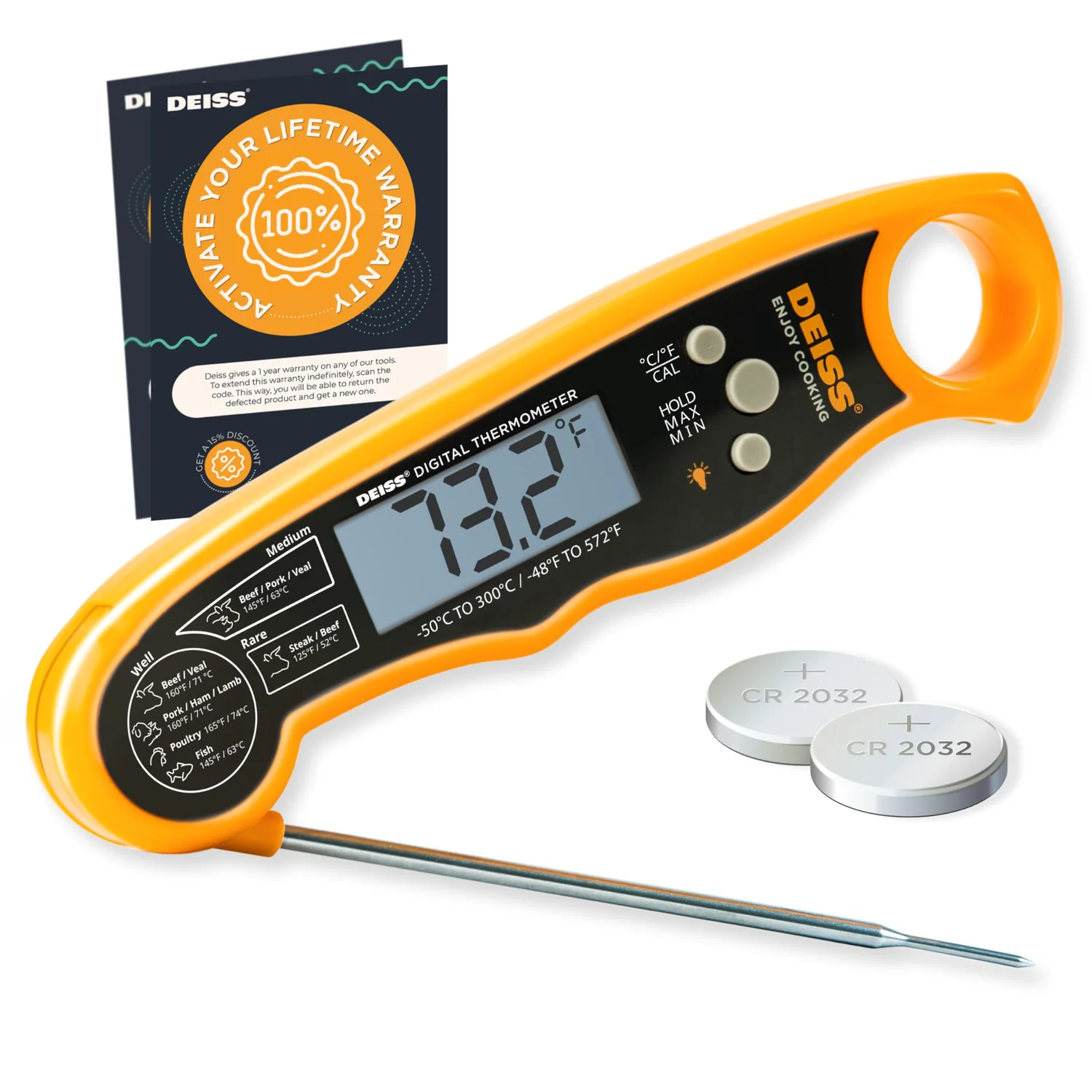
We make one: the Deiss PRO Digital Meat Thermometer, built around a fast read time and a display you can actually see at the oven.
Whichever you use, the point is the same — one measurement replaces a lot of hoping.